
Why the path to financing cannot be packaged as a "course."
There is no such thing as "selling the Room" 💩

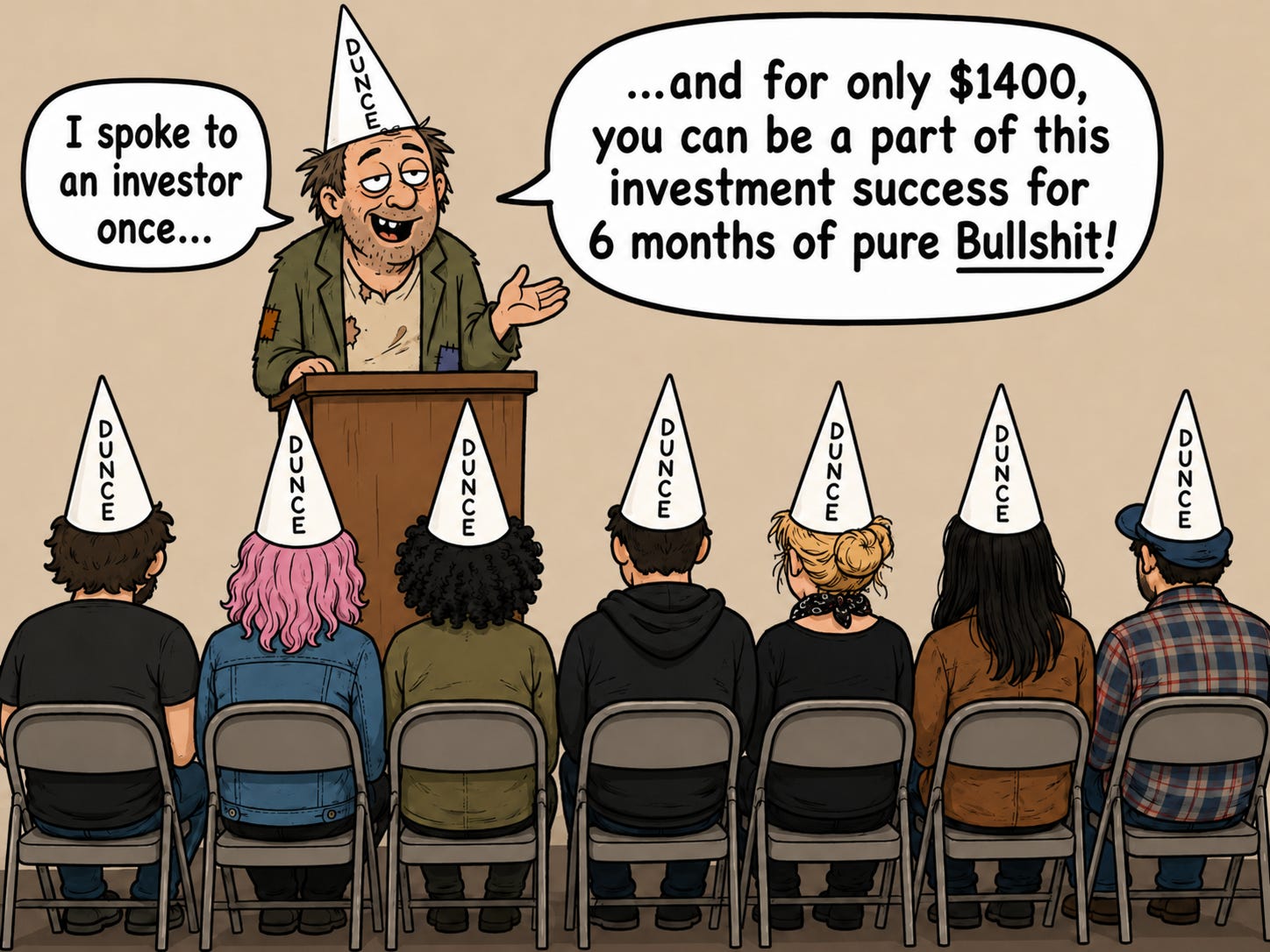
The promise underneath a multibillion-dollar corner of the online education industry is that raising money is a teachable sequence. Enroll, complete the modules, attend the sessions, emerge fundable.
The coaching industry generated roughly $7 billion globally in 2025, up from under $3 billion in 2019, and the broader online learning market passed $200 billion the same year. Inside those figures sits a thriving sub-sector aimed at people trying to finance something in “pitch accelerators, fundraising bootcamps, investor-readiness cohorts, producer labs, founder masterminds.” The durations vary, 6 weeks, 6 months, some now stretching past a year. The premise never does, and the premise is wrong before a single legal problem enters the picture.
Financing is not a course-shaped problem. The path to investment is meticulous, tedious, and specific to each project or product, and no fixed-length curriculum has ever changed that. To understand why the product exists anyway, look at HOW it gets made and HOW it gets sold, because the machine has 2 ends and neither one touches the actual work.
The 1st avenue is SUPPLY, and it explains WHY the category grows regardless of whether anyone ever raises a dollar. A done-for-you production industry now prospects anyone holding a credential, an audience, or a plausible title, offering to build the entire course under that person’s name in script it, film it, edit it, run the ads, manage the funnel, split the revenue. The expert contributes a face and a bio. The agency contributes everything else, including, in many cases, the substance.
The consequence is a market flooded with instruction on “raising” private equity authored functionally by marketing companies, where accuracy is nobody’s assigned job and the securities-law implications of the content are nobody’s department at all. Generative AI finished the job by pushing production cost toward zero, so the constraint on supply is no longer expertise or even effort. It is the availability of faces. This is WHY the curricula converge in that of the same deck templates, the same pitch frameworks, the same recycled fundamentals, refreshed annually with a new year in the title.
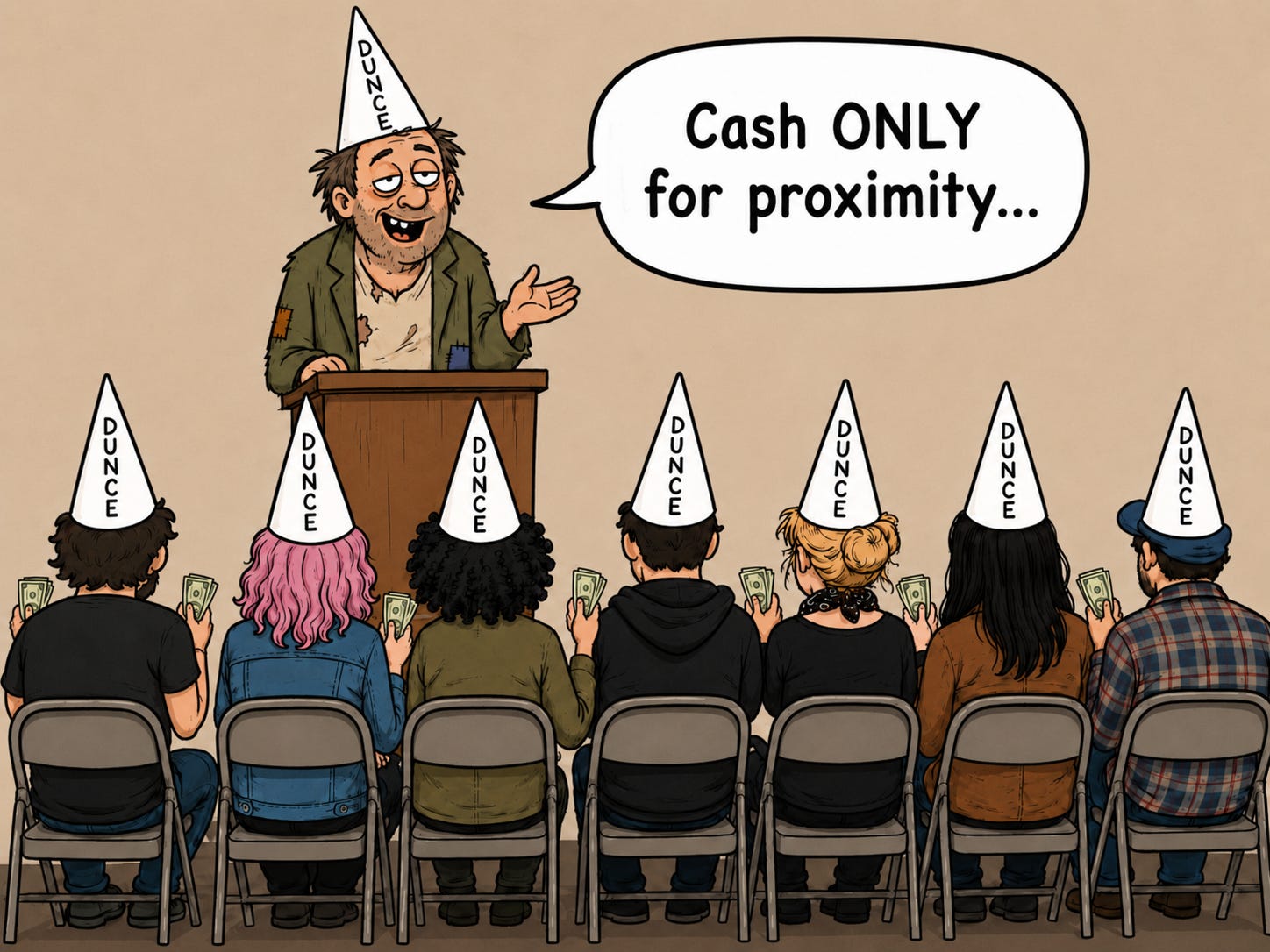
The 2nd avenue is DEMAND, and it is where the equity changes hands. Membership programs sell live access on recurring fees such as regular sessions advertised as conversations with investors, mentors, and money-adjacent figures of assorted description, plus a library of recorded lessons, plus community. The register shifts by target. Founders get urgency and conquest language. Creatives get softness, support, and permission. Enrollment windows open and close on schedules designed to manufacture deadline pressure, pricing is engineered to make the expensive option look considered, and the testimonials describe transformations no outsider can verify. Across every variant, the component doing the selling is never the curriculum, because the curriculum is the commodity the manufacturing end mass-produces. The component doing the selling is the “room” and proximity to the people with investment is the product, and proximity happens to be the one piece of the offer that federal law has something to say about.
The money side of all of this deserves its own examination because genuine, active financiers rarely need to appear on subscription video sessions to find deals, because deal flow finds them. The seats therefore fill with adjacent figures such as “aspiring angels, financiers between funds, executives” with titles that verify nowhere, and people whose primary investment is in being perceived as investors. The paying member cannot tell the difference from inside the call, and that information gap is the only condition under which the room holds its price.
The Federal Trade Commission has prosecuted this sector for decades across its earlier costumes in coaching and mentoring schemes, business-opportunity programs, real-estate riches systems, and investment seminars. The complaints repeat across 20 years with unfounded earnings claims, buyers urged to fund purchases with credit card debt, upsell ladders extracting the most from people who could least afford it, and contract gag clauses barring negative reviews, a practice that violates the Consumer Review Fairness Act.
In 2020 the agency ran a coordinated sweep against money-making schemes with 19 federal, state, and local partners. In 2021 it put more than 1,000 companies on formal notice that deceptive earnings claims carry civil penalties. FTC actions returned $324 million to consumers in 2023 and over $339 million in 2024, with coaching cases a recurring slice. The category absorbed all of it, because the penalty calculus favors the seller in that judgments get suspended, refund checks average in the low hundreds against losses in the tens of thousands, and a banned operator reappears under a new entity with the funnel intact. The rational response to enforcement was never to stop. It was to migrate, and the migration destination was access, the thing the FTC’s earnings-claim framework reaches least and securities law reaches most.
Section 15(a) of the Securities Exchange Act of 1934 requires anyone engaged in the business of effecting securities transactions for others to register as a broker. 9 decades of case law and staff guidance define what crosses the line in soliciting investors, distributing offering materials, arranging meetings between companies and prospective backers, and above all, receiving compensation connected to whether money moves. There is no general federal exemption for finders. The SEC proposed one in October 2020, a 2-tier safe harbor for limited introductions to accredited investors, and never adopted it. Its own small-business advisory committee revived the discussion in July 2025, petitions followed into 2026, and the law today is identical to 2019 in no safe harbor, no registration-lite category, plus state regimes layered on top.
Enforcement is current.
In January 2025 the SEC announced settled charges against multiple individuals for unregistered broker activity in private offerings, describing conduct that maps directly onto the access industry’s design with payments for investors successfully solicited, marketing materials placed in front of prospects, an unregistered sales force recruited to widen the funnel, and aiding-and-abetting liability for the person who built the pipeline. The factor test is decades old in whether a fee is contingent on an investment, whether it grows with the investment’s size, whether the intermediary solicited or negotiated. The access industry’s standard hedge is to sell “the room” while disclaiming the transaction, billing sessions as dialogue and relationship-building. The hedge holds only while nothing happens in “the room”, and the marketing requires things to happen in “the room”, because member raises are the only proof of value the product can show.
Securities sold through an unregistered broker carry rescission exposure under Section 29(b) of the Exchange Act, which makes contracts formed in violation of the Act voidable. An investor who sours on the deal later may have a legal route to demand the investment back with interest from the company that took it. General solicitation compounds that most small private raises rely on Rule 506(b) of Regulation D, which prohibits general solicitation and presumes a substantive pre-existing relationship with the people being pitched. Presenting to strangers assembled by a paid membership is the textbook fact pattern that endangers the exemption, and a blown exemption converts the whole offering into an unregistered sale of securities. The customer bought a shortcut and acquired a contingent liability that follows the project for years.
So…..where is the proof?
After 2 decades of this market, there is almost no rigorous, independent evidence that a standalone paid course, the $997 to $10,000 tier of modules, templates, and video libraries sold directly to founders and filmmakers, has causally taught significant numbers of buyers to close meaningful financing. What exists instead is self-reported aggregates, survivorship-curated testimonials, and data borrowed from categories that are not courses at all.
The closest the record comes to proof involves selective, intensive programs that share nothing with the retail course market except vocabulary.
Y Combinator and Techstars publish verifiable aggregate results, and analyses of YC cohorts show follow-on funding rates far above baseline, but those programs accept low single-digit percentages of applicants, inject money, provide sustained mentorship, and confer a brand signal that financiers price on its own. Founder Institute advertises thousands of alumni companies and billions raised in aggregate. Research on accelerators consistently finds that graduates outperform non-participants while also finding that within any cohort, the team and its traction predict the raise far better than the curriculum does. Selection and network are doing the lifting, and the same holds for university programs whose alumni raise billions cumulatively on the strength of pedigrees the program filtered for rather than created. Nonprofit fundraising certificates report high alumni satisfaction, and they operate in an institutional, relationship-driven domain that has nothing to do with startup equity or film finance.
Strip those categories out and the standalone course market stands naked. Operators tout 8-figure alumni raise totals with no public list of who raised, no round sizes, no before-and-after comparison, and no accounting for what motivated buyers with existing traction would have closed anyway. There are no matched comparisons, no third-party audits, and no large-scale studies showing causal impact from a paid online course on closed financing, in any domain, ever. At a 3% pre-seed funding rate, ordinary selection explains every testimonial the category has ever produced. For indie film masterclasses specifically, the record thins to nothing: not one audited portfolio of projects financed because of a course exists anywhere.
The vacuum is not an accident of young data. Sellers optimize for sales, and the standard disclaimer kit, results not typical, your effort required, transfers accountability to the buyer at the moment of purchase while the marketing transfers credit to the seller at the moment of anyone’s success. If a course repeatably produced raises, its operator would publish participant-level funding data, run matched comparisons, submit results to outside verification, and display a placement record an outsider could check, because that evidence would be the most valuable marketing asset in the category’s history. No operator has ever done it. The product that cannot afford to measure itself has told you its measurement.
So now, the brutal truth…
Raising money is not generalizable, because every question that determines whether a project gets financed is answerable only for that project.
A film lives or dies on its specific rights chain and how cleanly it transfers, the actual returns of genuinely comparable titles through each revenue window, the incentive programs available in its specific shooting jurisdictions, the realistic order in which its particular mix of money gets repaid, and which of a small number of financiers funds work at that budget, in that genre, at that stage.
A startup lives or dies on the shape of its traction, the design of its specific round, and the 30 or 40 investors whose theses actually fit, approached in a specific order, with materials built for THIER diligence process.
Nothing on either list transfers to the next project. The risk geography is different. The right investors are different people.
The tedium is the point, and the tedium is unteachable in the abstract. It looks like confirming that every agreement in a rights chain was actually countersigned, because financiers have walked from deals over a single missing signature. It looks like reconciling 3 conflicting revenue figures for the same comparable title and determining which one came from a party with a reason to inflate it. It looks like reading the fine print of an incentive program and discovering the headline percentage applies to a narrower spend base than the pitch assumed, which quietly rewrites the entire budget. It looks like restating projections 5 times because each pass surfaces an assumption that cannot be defended out loud.
None of this fits a module, because every item exists only in relation to one specific project’s documents, numbers, and people.
Relationships that produce funded deals accumulate across years. Readiness is iterative in which a financial case gets built, attacked, rebuilt, and attacked again until it stops breaking. Diligence preparation means anticipating the specific objections this project will draw and answering them in writing before anyone asks. Roughly 3% of pre-seed applicants get funded, fewer than 40% of seed companies reach Series A, and most independent films never recoup through traditional release patterns, NOT because applicants lack information, but rather because most projects arrive unready, and readiness is produced by tedious project-specific labor that ends when the project is ready. A course ends when the billing cycle does. The fixed duration of 6 months or 18, understand that the length was chosen by a payment processor, not by the work. Anything that fits every project at once, by definition, addresses NONE of them.
Which means that the counter to the course is not a better course. It is the unglamorous sequence the course was invented to let buyers skip. Traction comes before investment, because the funding rate without hard signals sits in the low single digits and no amount of fluency changes what a financier sees when there is nothing to see. For a startup that means revenue, users, pilots, or pre-commitments produced before the raise begins. For a film, what it used to mean was attachments with market value, a sales agent engaged early, evidence of an audience tested cheaply through short-form work or a validation campaign, and every supporting document already assembled in a clean data room.
Building the proof is slower than buying the promise.
The financing itself is an assembly, never a single event, and each layer is sized by the specific project.
Incentive programs and soft money carry predictable value and function as collateral, but only at the percentages and spend definitions of the actual jurisdictions involved.
Pre-sales still move for genre work in certain territories and barely exist elsewhere.
Audience campaigns prove demand and cover gaps without pretending to fund a budget.
Lenders advance conservatively against the collateral the earlier layers created.
Equity enters last, from sophisticated parties who can see the whole assembly and price the remaining risk honestly, often through a vehicle built for the single project.
Every fraction in that sequence depends on this budget, this genre, these jurisdictions, these rights, and this team, which is the thesis of this entire piece restated as a to-do list.
Where outside help legitimately exists, it carries skin in the game. Selective accelerators invest money, deliver sustained mentorship, and confer a signal financiers price independently, and their brutal acceptance rates are the source of that value rather than a flaw in it. Institutional film labs and fellowships with long track records operate the same way. Beneath all of it run relationships built across years by being genuinely useful to people before needing anything from them.
None of this can be purchased on a monthly billing cycle, and assembling all of it, in the right order, for one specific project, is a job.
That job has a name.
This is the case for consulting, and it rests on incentive design rather than promotion. A consultant operating correctly in this space sells no introductions and takes no compensation tied to money raised, because either would land them in the same registration trap the access sellers occupy. What legitimate consulting delivers is the project-specific work described above, performed before an investor performs it hostilely by way of due diligence on the actual project, identification of the holes in its actual financial case, comp analysis built from its actual peers, an offering assembled inside compliance lines with real securities counsel where the law demands one.
The engagement is bespoke because the problem is.
It runs as long as the project needs.
Sources for verification:
ICF-derived coaching market analyses ($6.25B in 2024, ~$7.3B in 2025); Statista Digital Market Insights, global online learning market ($203.8B in 2025)
FTC enforcement history on coaching, mentoring, and business-opportunity schemes; Operation Income Illusion sweep (Dec. 2020); Notice of Penalty Offenses on earnings claims to 1,100+ companies (Oct. 2021); FTC annual refund totals ($324M in 2023, $339M in 2024); Consumer Review Fairness Act
Securities Exchange Act of 1934, §§ 15(a), 29(b)
SEC Proposed Exemptive Order for Certain “Finders,” Rel. No. 34-90112 (Oct. 7, 2020), never adopted; SEC Small Business Capital Formation Advisory Committee meeting (July 22, 2025)
SEC Press Release 2025-7 (Jan. 14, 2025) and related orders on unregistered broker activity in private offerings
Brumberg, Mackey & Wall, P.L.C., SEC Staff Denial of No-Action Relief (May 17, 2010)
Regulation D, Rule 506(b), 17 C.F.R. § 230.506(b)
Pre-seed/seed funding and startup survival base rates, 2025 platform and cohort analyses
Accelerator research on participant vs. non-participant performance and within-cohort selection effects; published YC and Techstars aggregate follow-on data; Founder Institute self-reported alumni totals
It’s Friday.
If you are trying to build something on your own outside the same tired industry lanes, this is your reminder to come along for the ride.
ReturnToSender is for filmmakers, creators, founders, and anyone tired of being told to wait for permission from people who are usually just guessing.
Follow. Like. Share. Subscribe.
Build for yourself.
Own your audience.
Question the machine.
If you have spent time trying to get a project financed and walked away feeling like you missed something, like the answer was just out of reach, like the next introduction or the next attachment or the next festival would finally move the needle — this Video is for you.
What is your Risk Adjusted Project Profile?
Return the rest to sender.

Like, Share, Subscribe, and Follow on:
YouTube: www.youtube.com/@ReturnToSenderASAP
Rumble: www.rumble.com/user/ReToSender
LinkedIn: @Rapp Consulting / @Sean Rappleyea
Instagram: @returntosenderasap
X: @ReToSender
Sign up for my Newsletter: www.rapp.consulting
For more in depth insights: www.rapp.consulting/blog
